
The Sky contract end date matters more than almost any other date on the account, because everything about your bargaining position changes the day it passes. Before it, leaving costs money. After it, the discounted offer price falls away, the bill drifts up to the standard rate, and Sky suddenly has every reason to talk.
The date itself is not hard to find once you know where Sky keeps it, and since 2020 Sky has been legally required to tell you it is coming. This guide covers where the date lives, what the end-of-contract letter actually means, the notice periods for cancelling, how One Touch Switch changed leaving Sky broadband, and why the weeks after the minimum term ends are the best negotiating window you will get.
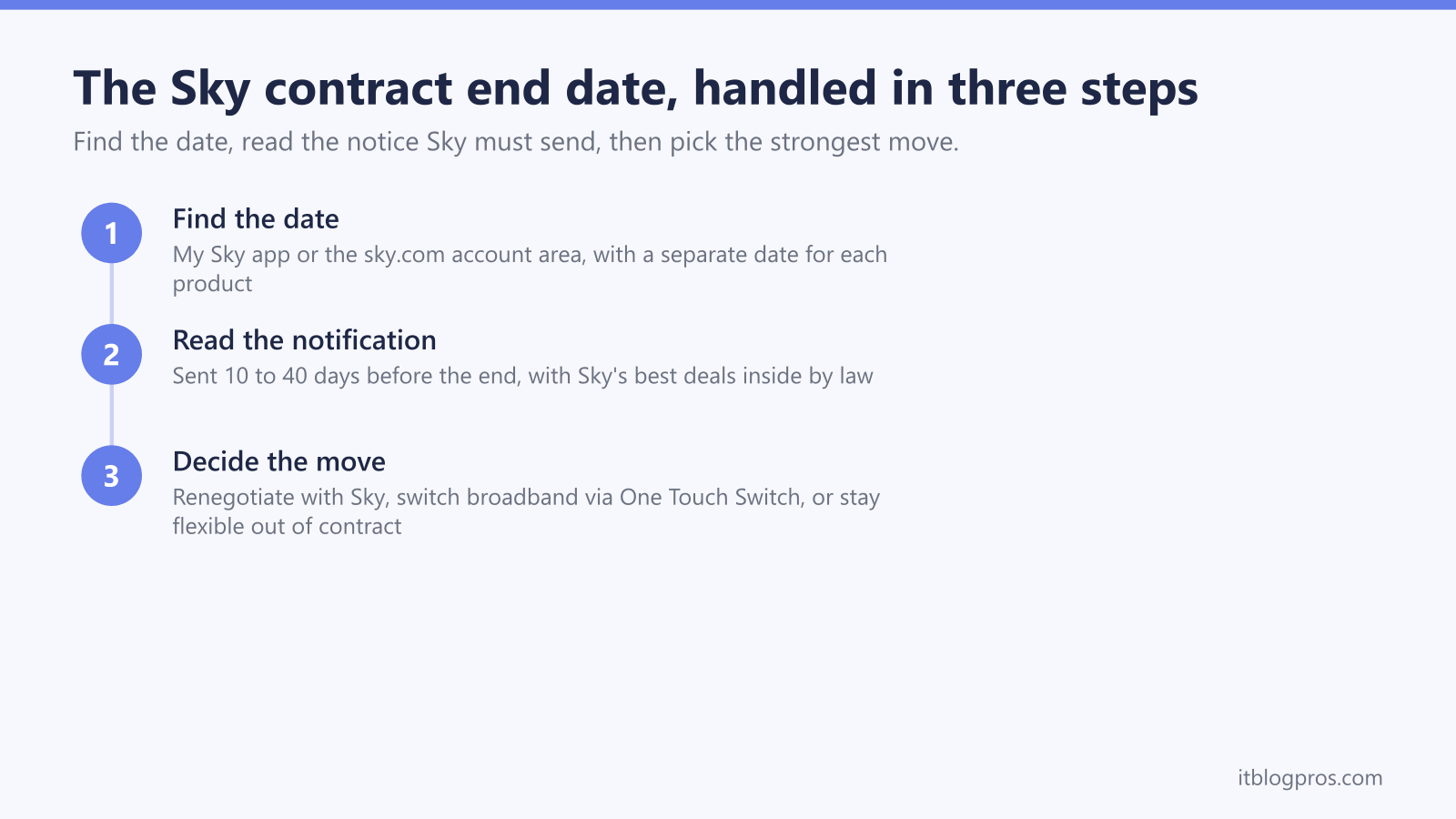
Sign in to My Sky online or in the My Sky app and open the area listing your products to see the contract end date for each Sky service. The same date appears in the end-of-contract notification Ofcom requires Sky to send 10 to 40 days before the minimum term ends. After that date the service rolls on at the standard price, so the run-up to it is the moment to renegotiate or switch.
Key Takeaways
- The contract end date sits in the My Sky app and the online account area, listed per product, and every end-of-contract letter and bill repeats it.
- Ofcom rules force Sky to warn you 10 to 40 days before the minimum term ends and to include its best available deals in that notification.
- Nothing switches off when the minimum term ends; the service rolls on month to month at the standard price until you act.
- One Touch Switch means the new broadband provider handles the whole move, so leaving Sky broadband needs no goodbye call to Sky at all.
- Out of contract is the strongest bargaining position, because no early termination charge stands between you and a better deal elsewhere.
Where Sky keeps the contract end date
Sky shows contract details inside your account, both on the website and in the My Sky app. Sign in with your Sky iD and open the area that lists your products and package; the contract or offer end date is shown against each service. Sky moves the labels around from time to time, so the exact wording shifts, but the date always lives with the product it belongs to. Broadband, TV and mobile are separate contracts, often started on different days, so expect a different end date against each one.
Three other places confirm it:
- The Message Centre inbox in your Sky account. The end-of-contract notification lands here as well as in your email, and it states the date in plain terms.
- Your bills. Offer pricing is shown with the discount and its end date, which is the same thing as the minimum term ending for that product.
- Sky directly. The messaging team or a phone agent can read out the exact minimum term end date for every product on the account, which settles any doubt when the online view is ambiguous.
One common misconception is worth clearing up: there is no text-message shortcode for checking a Sky TV or Sky Broadband contract. The SMS route exists only for mobile. Sky Mobile customers can text INFO to 85075, a free Ofcom scheme running since July 2019, and get a reply stating whether the mobile plan is in contract and what any early termination charge would be. For TV and broadband, the account area and the notification letter are the tools.
The end-of-contract notification is a legal safety net
Since 15 February 2020, Ofcom has required every broadband, phone, TV and mobile provider to send an end-of-contract notification between 10 and 40 days before the minimum term runs out. Sky has no discretion here; the notice must arrive by text, email or letter, and it must tell you:
- the date the minimum term ends
- what you pay now and what you will pay once the contract ends
- the notice period for leaving
- the best deals Sky currently offers, including prices available to brand-new customers
That last point is the sharp end of the rule. Providers historically kept their best pricing for new customers while loyal ones drifted onto expensive standard rates, and the notification exists to put those new-customer prices in front of you at exactly the moment you are free to act.
The protection does not stop there. Anyone who stays with Sky past the end date without recontracting gets an annual best-tariff reminder, once a year, restating what they are on, what the best available tariff is and how to change or cancel. Missing the first letter does not mean missing the boat.
Treat the notification as the most useful document Sky sends all year. It is the baseline for any negotiation: whatever Sky quotes on the phone can be measured against the deals its own letter admitted to.
The minimum term ending changes the price, not the service
Nothing turns off when a Sky contract ends. The minimum term is the period you committed to; once it passes, the same services carry on under a rolling arrangement that either side can end with notice. The practical change is the bill. Introductory and offer pricing is tied to the minimum term, so when it lapses the price typically steps up to Sky's standard rate for the package.
Ending a service is a matter of notice, and the notice periods differ by product:
- Sky TV works on 31 days' notice once out of contract.
- Sky Broadband and Sky Talk need 14 days' notice when cancelling outright, for example when moving to a network that cannot take over the line automatically.
Billing continues through the notice period, and any overpayment past the final day is credited back. When cancelling, Sky confirms the final billing date in writing; keep that confirmation, because it is the reference if a later bill looks wrong. Loaned equipment such as hubs and Sky Stream pucks has to go back, and proof of posting is worth keeping.
Giving notice slightly before the end date is allowed and often sensible. Notice can overlap the tail of the minimum term so the service stops close to the day the contract ends, rather than paying standard rate for an extra month while the clock runs.
One Touch Switch removes the goodbye call for broadband
Since 12 September 2024, UK broadband switching has been led by the gaining provider under Ofcom's One Touch Switch system. Leaving Sky broadband for another ISP now involves no call to Sky at all. Sign up with the new provider, and it contacts Sky on your behalf, coordinates the switch date, and your Sky broadband ends automatically when the new service goes live. The system covers broadband and landline, and it works across different networks, so it applies whether the move is to another Openreach provider, to Virgin Media or to a full-fibre altnet.
During the process Sky must send you information about the consequences of leaving, including any early termination charge if the broadband is still in its minimum term, so there is a built-in chance to back out before charges bite.
Two boundaries matter:
- Sky TV is not covered. One Touch Switch is a broadband and landline system. A Sky TV subscription bundled alongside the broadband carries on until you cancel it separately with Sky, on its own 31 days' notice. Forgetting this is the classic way to end up paying for TV months after the broadband has gone.
- Sky Mobile is not covered either. Mobile has its own Ofcom switching scheme using PAC and STAC codes by text.
The old fear of the retention gauntlet, an hour on hold to be talked out of leaving, is gone for broadband. That alone changes the negotiating balance, because Sky knows you can leave without ever speaking to it.
Leaving mid-contract costs money, with narrow exceptions
Cancelling inside the minimum term triggers an early termination charge. Sky's published approach is that the charge roughly equates to the remaining monthly payments to the end of the minimum term, reduced to reflect costs Sky saves, and charged at a lower rate where you were paying an offer price. Sky publishes an early termination charges table on its help pages; the exact figure for a given account depends on the products, the offer pricing and the months remaining, so the honest advice is to get the figure from Sky before deciding anything. No guide can state it for you.
There are legitimate ways out without the charge:
- The cooling-off period. New orders placed at a distance carry a statutory 14-day cooling-off window from activation, and cancelling within it avoids the minimum term entirely.
- Mid-contract price rises beyond what the contract allowed. Under Ofcom's rules, a provider that raises prices in a way the contract did not clearly commit you to must give at least 30 days' notice and let affected customers exit that contract penalty free within the notice window. The price-rise letter or email must state whether the right to leave applies. Since 17 January 2025 new contracts must set out any planned rises in pounds and pence up front, which means a rise that was clearly written into the deal you agreed does not reopen the exit right; a rise beyond it can.
- Sky failing to deliver the service. Persistent faults that Sky cannot fix can, after Sky's complaints process and the ombudsman if needed, justify release from the contract. This is a process rather than a loophole, and it needs a documented fault history.
Read every price-rise notification carefully rather than assuming either way. The penalty-free window is short, and it closes.
Out of contract is the strongest negotiating position
Every element above points the same way: the weeks after the minimum term ends are when a Sky customer holds the cards. The early termination charge is gone, One Touch Switch means leaving broadband takes one sign-up with a rival, and Sky's own end-of-contract letter has already disclosed its better prices.
The negotiation itself is unglamorous and effective:
- Note the standard price now being charged and the best deals from Sky's own notification.
- Gather two or three genuine quotes from rival providers for an equivalent package.
- Contact Sky, say the contract has ended and the price no longer works, and ask what it can do. The conversation routes to retentions, where the meaningful discounts live.
- Judge the offer against the rival quotes, not against the inflated standard rate, and be genuinely prepared to switch, because the maths only works when the alternative is real.
A recontract restarts a minimum term, so a good discount comes with a fresh commitment; check the length before agreeing. Staying out of contract entirely is also a valid choice, paying standard rate month to month for maximum flexibility, and the annual best-tariff reminder keeps arriving as long as that continues.
The connection deserves a health check before the decision
A surprising number of people switch provider to escape problems that were never the broadband line's fault. Slow speeds upstairs, dropouts in the evening and dead zones in the garden are usually WiFi problems inside the house, and they will follow you to the next provider's router.
Before using the contract end date as an escape hatch, it is worth an hour of diagnosis. The Sky WiFi problems and solutions guide works through the common failure patterns, and the beginner's guide to fixing Sky broadband WiFi signal covers hub placement and the cheap wins that transform coverage. Checking the hub's own status pages helps too; the Sky Hub login guide explains how to get into the admin panel on every hub model.
If the line itself tests fine and the WiFi is fixable, the decision becomes purely about price, and the negotiating position above does the rest. If the service genuinely underdelivers, that history of documented faults strengthens the case for leaving, in contract or out.