
Search for an Ethernet cable to go with a Virgin Media hub and the listings push Cat 7, Cat 8, gold-plated connectors and braided sleeving at prices that make no sense for a lead that plugs a telly into a router. The honest answer is far more boring, and far cheaper, than the marketing suggests. This guide gives the straight recommendation first, then the handful of details that genuinely separate a good cable from a bad one.
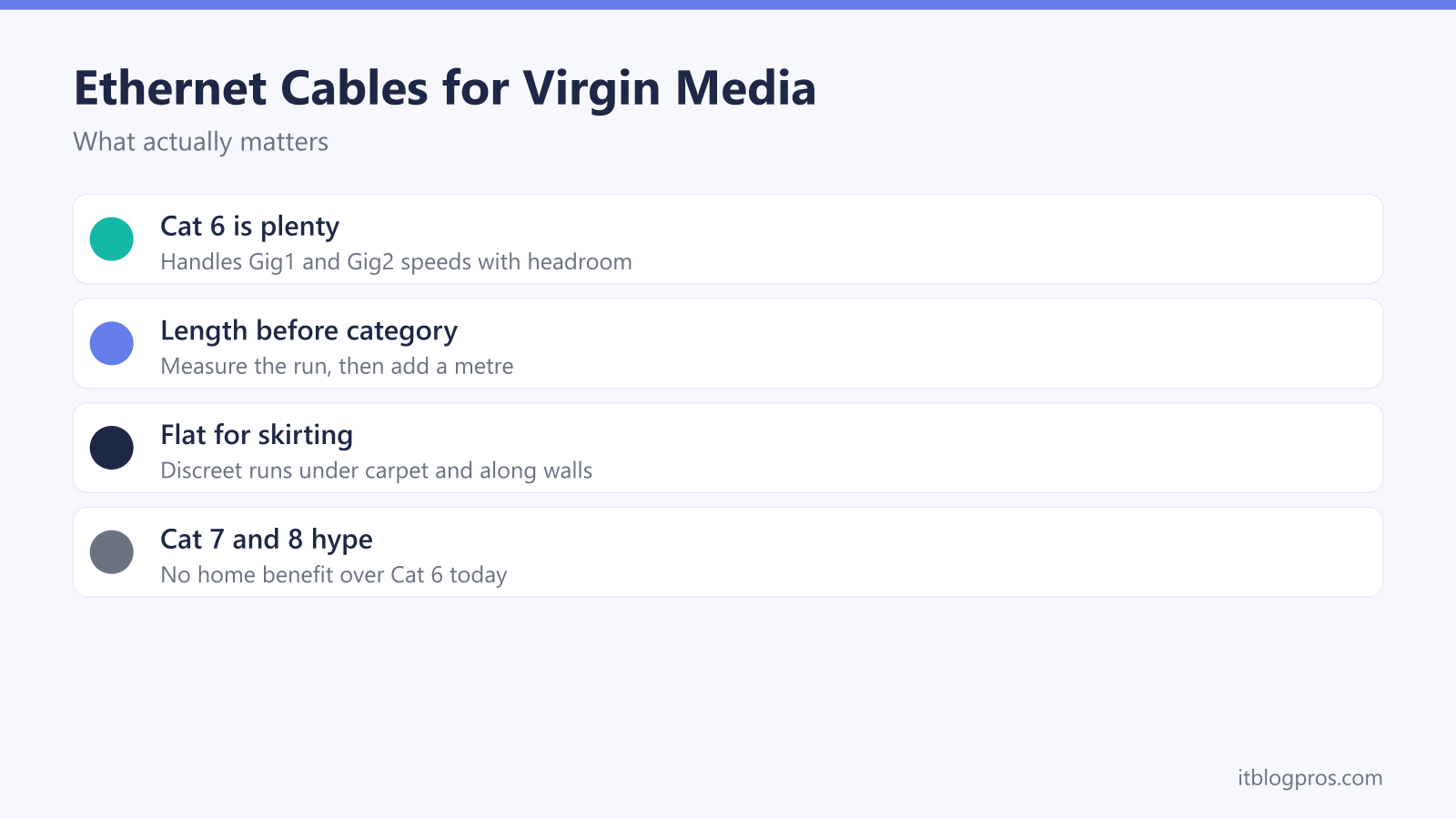
A Cat 6 cable is the best Ethernet cable for Virgin Media, and it covers every package the company sells, Gig1 and Gig2 included. Any genuine Cat 5e cable already carries full gigabit, so the category number matters far less than the length, the shape and the brand. Measure the run, add a metre, pick flat for skirting-board routes, and buy from a name that states pure copper.
Key Takeaways
- Cat 6 handles every package Virgin Media sells, including Gig1 and Gig2, with headroom to spare.
- Any genuine Cat 5e cable already carries full gigabit, so the category number matters far less than sellers pretend.
- Length, flat versus round shape, snagless connectors and a trustworthy brand are the details that actually decide a purchase.
- Cat 7 and Cat 8 add nothing over Cat 6 in a home; the money buys shielding a house cannot even use.
- The hub port sets the ceiling on Gig2, since only the Hub 5x's 2.5Gbps port lets one wired device pass gigabit.
Cat 6 covers every Virgin Media package with room to spare
The numbers make this quick. Gigabit Ethernet has run happily over Cat 5e since the standard arrived in 1999, and Cat 5e is rated for it at the full 100 metre limit. Virgin's fastest widely available package, Gig1, advertises average speeds a little over 1Gbps, and even Gig2 on the newer full-fibre network sits around 2Gbps. Cat 6, rated to 250MHz, carries 2.5Gbps and 5Gbps over a full-length run and 10Gbps over shorter ones, which lands comfortably past anything Virgin sells or has announced.
So the honest recommendation reads like this: buy Cat 6, because it costs pennies more than Cat 5e and covers every upgrade Virgin could offer for years, and keep any genuine Cat 5e lead already in the drawer, because it does full gigabit just fine. The category printed on the sleeve matters far less than cable sellers would like everyone to believe. Past Cat 6, the extra money buys nothing a home can use.
That last point corrects something the older version of this page danced around. A higher category cable does not speed up a Virgin connection; the package sets the speed. A cable either carries that speed cleanly or it does not, and every genuine Cat 5e or Cat 6 lead carries it cleanly.
The details that actually decide which cable to buy
Once category anxiety is out of the way, four practical things separate a good purchase from a bad one.
Length comes first. Measure the route the cable will actually follow, along the skirting, up and over the door frame, around the alcove, rather than the straight line between the hub and the device. Then add at least a metre for slack at each end. A cable 50cm too short goes in a drawer forever, while a metre of spare tucks away invisibly. The 100 metre limit on Ethernet is a non-issue indoors; no lounge-to-bedroom run gets anywhere near it, and length has no meaningful effect on speed at domestic distances.
Shape matters more than people expect. Flat cables sit tight against skirting boards, slide under carpet edges and pass beneath doors without turning into a trip hazard, which makes them the right choice for most indoor runs. Round cables are a little tougher and easier to pull through conduit or a loft, so they suit hidden and permanent runs. For a route out to a shed or garden office neither is right; that job needs external-grade cable, and the garden network cable guide covers it properly.
Snagless connectors save clips. The little plastic boot around the RJ45 clip is the difference between a cable that survives being pulled through furniture and one with a snapped clip that falls out of the port every week.
The brand claim needs to be true. This is the quiet scandal of cheap Ethernet cable: listings that print Cat 6 or higher on cable that could never pass the test, and conductors made from copper-clad aluminium (CCA) rather than pure copper. CCA has higher resistance, performs worse over longer runs and does not meet the actual Ethernet cabling standard. A reputable brand that states pure copper conductors is worth the small premium over an unbranded lead with an implausible spec.
Cat 7 and Cat 8 add nothing in a home
The plain version first: a Cat 7 or Cat 8 cable plugged into a Virgin hub performs identically to a Cat 6 one, and usually costs double.
Cat 7 is an odd standard. The formal specification uses different connectors entirely (GG45 and TERA), so a "Cat 7" cable with normal RJ45 plugs on the end is not really Cat 7 in the way the standard defines it; it is shielded cable sold under a label the buyer cannot verify. Cat 8 is a genuine standard, but it exists for 25Gbps and 40Gbps links inside data centres, over runs capped at 30 metres.
The shielding these cables carry also needs both ends properly earthed before it does anything useful, which consumer kit and Virgin hubs do not provide. Domestic interference is not the problem the listings imply either; a normal unshielded Cat 6 lead runs past power cables and behind televisions without measurable trouble. A flat cable sold as Cat 8 is the clearest warning sign of all, since a flat profile cannot meet Cat 8's shielded construction. That money buys a label, nothing more.
A wired connection beats WiFi for the boxes that never move
The best reason to buy an Ethernet cable on a Virgin line has nothing to do with cable categories. Anything that sits still and streams, a Virgin TV box, a games console, a desktop PC, a smart TV, performs better wired. Latency drops and stops jittering, buffering wheels disappear, and game downloads run at the full package speed instead of whatever WiFi manages through two walls.
There is a bonus most people never notice. Every device moved onto a cable stops competing for WiFi airtime, so the phones, tablets and laptops that genuinely need wireless all get a cleaner signal; one cheap cable to the telly can make the WiFi upstairs feel quicker. For rooms too far away for a tidy cable run, the wired internet in another room guide walks through the realistic options, Powerline and mesh included.
The pick: Jadaol flat Cat 6
One verified recommendation covers almost every home run, so there is no padded ten-product round-up here. The Jadaol flat Cat 6 is the cable we point people to: a slim flat profile that hugs skirting and slips under doors, snagless connectors, a wide spread of lengths, and cheap enough that ordering a metre or two spare costs almost nothing. It carries gigabit and 2.5Gbps without breaking a sweat, which covers everything from an M125 line to a Gig2 one.

For the jobs it does not suit, permanent loft runs, outdoor stretches and in-wall installs, a round pure-copper Cat 6 from any reputable brand does the same electrical job; pick an external-grade jacket for anything outside.
The hub port sets the ceiling, not the cable
One honest nuance finishes the picture, because it catches out Gig2 customers who blame the cable. Every gigabit Ethernet port tops out at around 940Mbps of real-world throughput once protocol overhead is counted, whatever cable is plugged into it. On the Hub 5x, the full-fibre hub that Gig2 arrives on, a single wired device only passes gigabit through the hub's 2.5Gbps port; plug into a standard port and the speed test stops at roughly 940Mbps with a perfectly healthy cable and line. The standard Hub 5 also carries one 2.5Gbps port, which gives Gig1 customers the same headroom.
Anyone running their own router faces the same arithmetic one hop later, because the router needs a multi-gig WAN port to pass the full speed along; that side of the chain is covered in the Hub 5 modem mode guide and the best router for Virgin Media round-up. The cable itself is the cheapest and least likely bottleneck in the whole setup. A genuine Cat 6 lead ends the conversation.