
Out past the last streetlight, mainstream broadband adverts stop meaning much, and the copper phone line, where one exists at all, delivers speeds measured in single digits. The situation has genuinely improved in the last few years though. Four realistic routes into a remote property now exist, and choosing between them comes down to what actually reaches the building rather than what a comparison site claims.
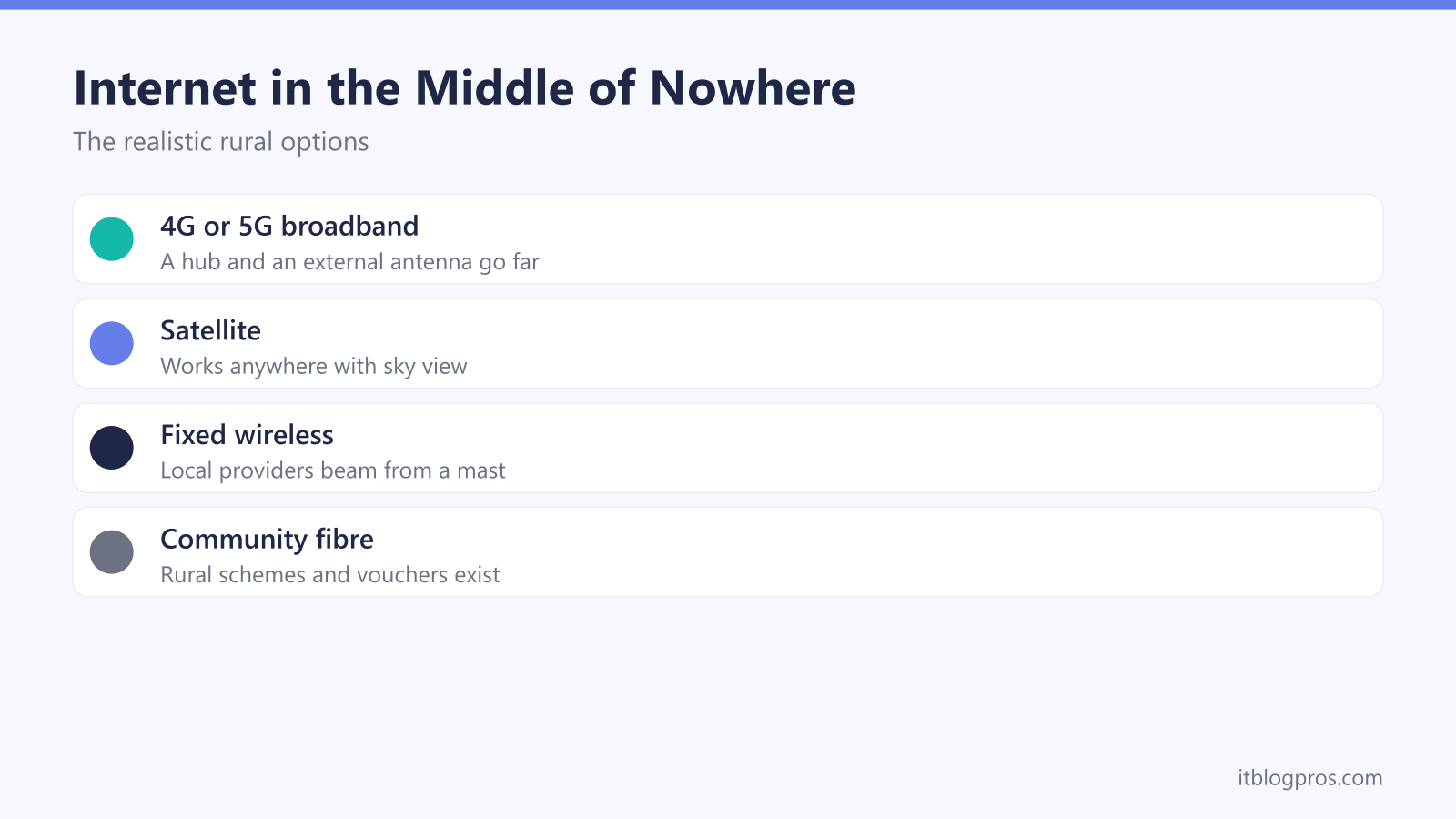
The realistic route to internet in the middle of nowhere runs in order of cost: 4G or 5G mobile broadband through a hub first, improved with an external antenna where the signal is marginal, then fixed wireless from a local WISP, then Starlink-class satellite for properties nothing else reaches. Community fibre schemes are the long-term fix where one exists. Long-range WiFi tricks and neighbour-boosting gadgets are not on the list.
Key Takeaways
- 4G or 5G mobile broadband is usually the cheapest rural option, and the right network is the one with the strongest mast near the property, not the one with the best national adverts.
- An external antenna mounted high on an outside wall regularly turns one flickering bar into a stable connection; marginal signal is exactly the case it exists for.
- Starlink-class low Earth orbit satellite works almost anywhere with a clear view of the sky, at a noticeably higher hardware and monthly cost than mobile broadband.
- Local WISPs and community fibre schemes are easy to miss because they rarely appear on mainstream comparison sites; neighbours and village noticeboards find them.
- Long-range WiFi gadgets that promise to grab a neighbour's signal across fields do not work, and the money is better spent on a proper 4G or 5G antenna.
The Option Ladder Starts With 4G and 5G Mobile Broadband
Mobile broadband is the first thing to try in almost every rural location, because it is the cheapest to test and the easiest to walk away from. The recipe is a home broadband hub, a SIM from whichever network has the strongest local mast, and a spot by the window facing that mast. Every major UK network now sells this as a packaged product with the hub included, and rolling monthly plans exist on several of them, which makes a genuine trial possible before any long commitment.
The critical point is that national coverage statistics mean nothing at a specific address; the only mast that matters is the one serving the property. Three might be flawless in the village and useless two miles up the lane, while O2 does the exact opposite. Checking each network individually at the property, covered properly further down, is what decides the SIM.
Speeds swing widely. A strong 4G connection handles streaming and video calls comfortably, a good 5G mast can outrun many fibre packages, and a weak signal on either can be dismal. The supplied hubs are basic but workable, and anyone wanting proper WiFi through a rambling farmhouse can put their own router behind the hub later. The same hub-and-SIM recipe also happens to be the tidiest way to run a separate connection in a family home, since nothing about it touches the existing line.
An External Antenna Transforms a Marginal Mobile Signal
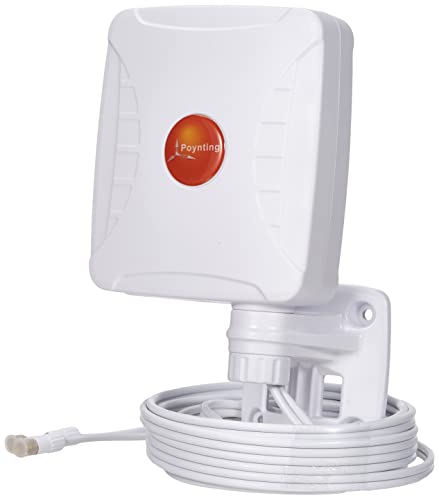
The gap between one flickering bar indoors and a stable connection is usually the walls, not the mast. Thick stone soaks up mobile signal, so a hub on a kitchen shelf often reports a hopeless connection while the signal outside, three metres up the same wall, is perfectly serviceable. An external antenna exists for exactly this case: it mounts high on an outside wall or a short pole, picks up the mast cleanly, and feeds the signal down a cable into the hub's antenna sockets.
On marginal signal, the results are the difference between abandoning mobile broadband and living on it, with documented setups showing signal readings improving by several decibels and speeds climbing to match. Two honest caveats apply. The antenna refines signal that already exists outside the property; where outdoor coverage is genuinely zero, it cannot conjure any. And the hub must have antenna sockets, which some models lack entirely, so the Three 5G Hub external antenna guide is worth reading first; it lists which hubs carry ports and covers the MIMO and cable-length details that decide whether the upgrade actually delivers.
For rural properties, an omnidirectional model such as the Poynting XPOL-1 is the forgiving choice, because it needs no precise aiming and keeps working if the serving mast changes. Directional panels offer more gain in exchange for careful alignment. Either way, the antenna is the single cheapest upgrade that moves a rural property up this ladder.
Starlink-Class Satellite Reaches the Places Mobile Cannot
Low Earth orbit satellite, with Starlink as the dominant example in the UK, changed the rural calculation completely. The old geostationary services parked a satellite so far away that every click took most of a second to respond; LEO constellations orbit close enough that video calls, remote desktops and ordinary browsing all feel normal. Coverage is the headline advantage: a dish with a clear view of the sky works in valleys, on islands and up tracks that no cable or mast will ever reach.
Honesty about the trade-offs matters. The hardware is an upfront purchase and the monthly cost sits well above a mobile broadband plan; exact figures change often enough that the only sensible advice is to check current pricing on the official site before deciding. Weather is a real but modest factor, since heavy rain or snow can cause brief interruptions, and the dish genuinely needs open sky, which makes overhanging trees a bigger enemy than clouds. The official apps include an obstruction checker that shows whether a proposed mounting spot is clear before any money is spent.
Traditional geostationary satellite broadband still exists and still covers the whole country, but high latency and tight data caps make it a last resort now rather than a fair comparison.
Local WISPs and Community Fibre Are the Easiest Options to Miss
Fixed wireless access is rural Britain's best-kept secret. Small local companies, known as wireless internet service providers or WISPs, mount transmitters on hills, church towers and grain silos, then fit a small receiver on each customer's roof aimed back at the mast. With clear line of sight the service is quick and stable, and because the operator is local, support usually means a person who knows the area rather than a call centre script. The catch is discoverability: WISPs rarely appear on comparison sites, so the reliable ways to find one are asking neighbours, searching the area name alongside terms like wireless broadband, and checking parish noticeboards and village Facebook groups.
Community fibre is the long-term answer where a scheme exists. Groups such as B4RN in the north of England have built full gigabit fibre to farms and hamlets no commercial operator would touch, usually with residents contributing funding or labour to the build. More broadly, Openreach and dozens of alternative networks keep extending full fibre into rural areas under commercial builds and the government's Project Gigabit programme. Being blunt about it, the hardest-to-reach properties sit at the end of every queue and published dates slip, so a rollout promise is worth registering interest in but never worth waiting for without an interim connection.
Deciding Comes Down to Checking, Not Guessing
The decision method is short and mostly free. Start with the coverage maps: Ofcom's mobile coverage checker shows all four networks at the exact address in one place, and each network's own checker adds detail. Treat every map as optimistic, because they model outdoor signal and a stone barn conversion is not outdoors.
Then test reality. Phones on different networks, borrowed from visitors or fitted with cheap pay-as-you-go SIMs, walked around the property and held up at bedroom windows, reveal in ten minutes what the maps only estimate. Neighbours come next, and their answer carries the most weight of all, because they have already run this experiment for years; whatever they use, and whatever they abandoned, is local ground truth no website can match.
Finally, check the fixed-line picture. Ofcom's broadband availability checker, the Openreach fibre rollout checker and the build maps of any altnet working locally show whether waiting for fibre is a plan or a fantasy at that address.
The Cost and Contract Picture Differs Sharply Between Options
Mobile broadband is the value pick. Monthly prices sit close to ordinary town broadband, the hub comes included, and rolling monthly plans turn the whole thing into a low-risk experiment; even contracted plans carry a cooling-off period if the service disappoints at the property. An external antenna adds a one-off cost roughly comparable to a decent router.
Satellite is the premium tier. Hardware is paid upfront, the monthly fee sits well above mobile broadband, and Starlink-class services are typically sold on rolling terms rather than long contracts, with current prices always on the provider's own site.
WISPs normally charge an installation fee for the receiver and mounting work, then a monthly fee somewhere between mobile broadband and satellite, usually on a 12 to 24 month term. Community fibre pricing generally lands close to urban full fibre once the network is built, though schemes can involve a contribution during the build itself. Rural providers vary far more than the national names, so the terms deserve an actual read before signing.
Home Workers Should Plan for Failure Before It Happens
Any single rural connection fails eventually, and a home worker discovering that mid-meeting has no good options left. The fix is a second connection on a different technology, kept deliberately cheap. A 4G SIM sitting in a dual-WAN router's failover slot switches over automatically for a few pounds a month, and covers the large majority of outages. Bonding services go a step further by combining two or more connections into one faster link that heals itself when either side drops, which suits anyone whose income depends on the line. Even a phone hotspot counts as a plan, provided the login details are written down before the outage rather than hunted for during it.
Long-Range WiFi Tricks Do Not Work
A persistent family of products promises to solve rural internet with WiFi: high-gain aerials that supposedly catch signal from miles away, boosters claiming to stretch a neighbour's network across three fields, repeaters aimed hopefully at the village pub. Physics and regulation kill all of it. Home WiFi transmits at legally capped low power and fades within tens of metres outdoors, so at field distances there is nothing left to boost, and an extender cannot repeat a signal it cannot receive.
Genuine point-to-point wireless links do exist, and WISPs are built on them, but they need proper directional equipment at both ends, clear line of sight, careful alignment and the cooperation of whoever owns the far end, and most consumer ISP contracts restrict sharing a connection between households in any case. Money hovering over a long-range WiFi gadget is better spent on a 4G or 5G antenna, which improves a signal that actually exists.